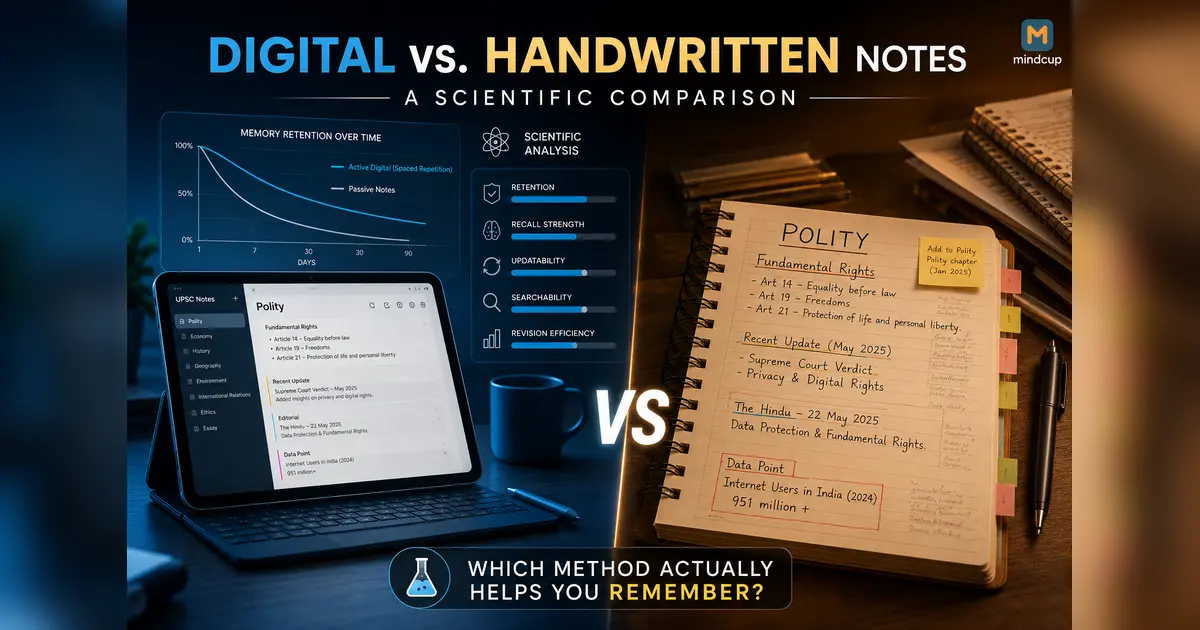
You are eight months into your UPSC preparation. You have a stack of thick, spiral-bound registers for General Studies. But adding yesterday’s Supreme Court verdict to a Polity topic you wrote in January means cramming tiny text into the margins or pasting messy sticky notes.
Or maybe you switched to digital tools. You flawlessly copy and paste The Hindu editorials into a clean workspace—only to realize during a mock test that you cannot recall a single specific data point.
This is the classic trap of the “Hybrid Mess.”
Traditional mentors insist you must write everything by hand to retain it. Modern advocates push for tablets to keep up with dynamic current affairs. Caught in the middle, you spend more time managing, formatting, and reorganizing your physical and digital notes than actually embedding them into your long-term memory.
The result is the Illusion of Competence. Your notes look comprehensive, but your actual recall is decaying. It is very similar to the highlighter illusion, where visual familiarity tricks your brain into thinking you know the material.
The secret to organizing your UPSC notes isn’t about picking the right medium; it is about fixing the cognitive mechanics of your retention. You need the editability of digital tools combined with the active cognitive friction of handwritten recall.
Let’s break down the cognitive science of why traditional note-taking fails over a two-year syllabus, and how to build a process-first preparation infrastructure that actually works.
What is Active Digital Note-Taking?
Q: What is Active Digital Note-Taking?
A: Active digital note-taking is a scientifically backed study method where digital notes are structured for mandatory cognitive retrieval rather than static storage. Unlike passive typing, it integrates active recall cues and spaced repetition algorithms to continuously test memory, preventing the natural decay of syllabus knowledge.
The Scientific Comparison: Handwritten Notes vs. Generic Digital Notes
To settle the debate of digital versus written notes for UPSC, we have to look at how the brain actually processes and stores information over long periods.
1. Traditional Handwritten Notes: High Friction and Zero Scalability for Dynamic Syllabus Updates
- The Pros: Writing by hand provides tactile feedback. It forces you to slow down, summarize, and synthesize information, which aids initial memory encoding. It also prevents screen fatigue.
- The Cons: Written notes are static; the UPSC syllabus is not. When a new economic policy updates a concept you wrote about six months ago, handwritten notes force you into messy rewrites. Furthermore, physical notes cannot be instantly searched, making cross-referencing a nightmare.
2. Generic Digital Notes (Notion vs. OneNote for UPSC): Infinite Storage but Low Retention
- The Pros: Highly search-friendly, infinite canvas, and incredibly easy to update with dynamic current affairs.
- The Cons: When comparing Notion vs. OneNote for UPSC, both suffer from the same fatal flaw: they are just digital filing cabinets. Because typing is fast and copy-pasting is effortless, aspirants fall into the “Collector’s Fallacy”—hoarding PDFs, links, and text blocks without true cognitive engagement. You build a beautiful, complex wiki, but your brain remains empty.
| Feature | Traditional Handwritten Notes | Generic Digital (Notion/OneNote) | Active Digital (Mindcup) |
|---|---|---|---|
| Searchability | Zero | High | High |
| Updatability | Very Low (Messy margins) | High | High |
| Cognitive Engagement | High (Manual synthesis) | Low (Passive typing/copying) | High (Forced active recall) |
| Revision Scheduling | Guesswork & manual tracking | Guesswork & manual tracking | Automated via FSRS Algorithm |
Resolving the Conflict: The Input vs. Output Strategy
Should you throw away your pens? Absolutely not. The UPSC Mains exam is ultimately a grueling, hand-written marathon. However, building your knowledge base and practicing your exam execution are two entirely different phases of preparation.
Q: How should I balance digital and handwritten notes for UPSC?
A: Adopt the Input vs. Output Strategy. Digital is for Input and Retention—use it to compile, search, and actively review your syllabus dynamically. Handwritten notes are for Output and Execution—reserve your physical writing stamina exclusively for mock tests, PYQ practice, and building muscle memory for the final exam.
How Mindcup Bridges the Gap
This is exactly why we built Mindcup. We wanted to end the Notion vs. written notes debate by combining the organizational power of a digital workspace with the cognitive rigor of physical study.
For the Early-Stage Aspirant
Getting your digital notes architecture right on Day 1 prevents the “Reality Check” panic six months down the line. Mindcup trains you to revise systematically as you go, stopping the accumulation of unrevised, forgotten materials.
For the Parallel Prepper (Working Professionals & Students)
If you are preparing for UPSC parallelly, digital notes are an absolute necessity because you need to study on the go. Mindcup allows you to execute high-yield, targeted revision sessions during a 15-minute commute, turning dead time into active retention.
The Mechanics of True Retention
Instead of just storing your text, Mindcup operates as an active thinking engine. It utilizes the FSRS (Free Spaced Repetition Scheduler) algorithm to predict the exact moment you are about to forget a topic.
When it is time to revise, the system doesn’t just ask you to re-read. It uses a progression of Guided to Unguided Recall:
- Guided Recall: Initially, you review the note layout, hide it, and attempt to remember it.
- Unguided Recall: As your proficiency grows, the system challenges you with unguided recall—forcing you to retrieve the information before you are allowed to see the note.
The “Scratchpad” Workflow
To maximize this process, we highly recommend the Scratchpad Method. Keep a cheap, blank rough register on your desk. When Mindcup prompts an Unguided Recall card, spend 60 seconds scribbling down keywords, mindmaps, or structural points on your scratchpad before clicking “Show Note.”
This combines the speed and organization of a digital database with the tactile, motor-memory benefits of physical writing exactly when it matters most—during active retrieval.
The Bottom Line
Your preparation is currently scattered across static registers, fragmented folders, and passive reading lists. It is time to transition from hoarding information to actually retaining it.
Mindcup brings structure, retention, and consistency into one system. Input your notes, and the system will present them to you systematically so that nothing leaks from your mind before exam day.
Stop managing your notes. Start retaining them. Experience Mindcup today.