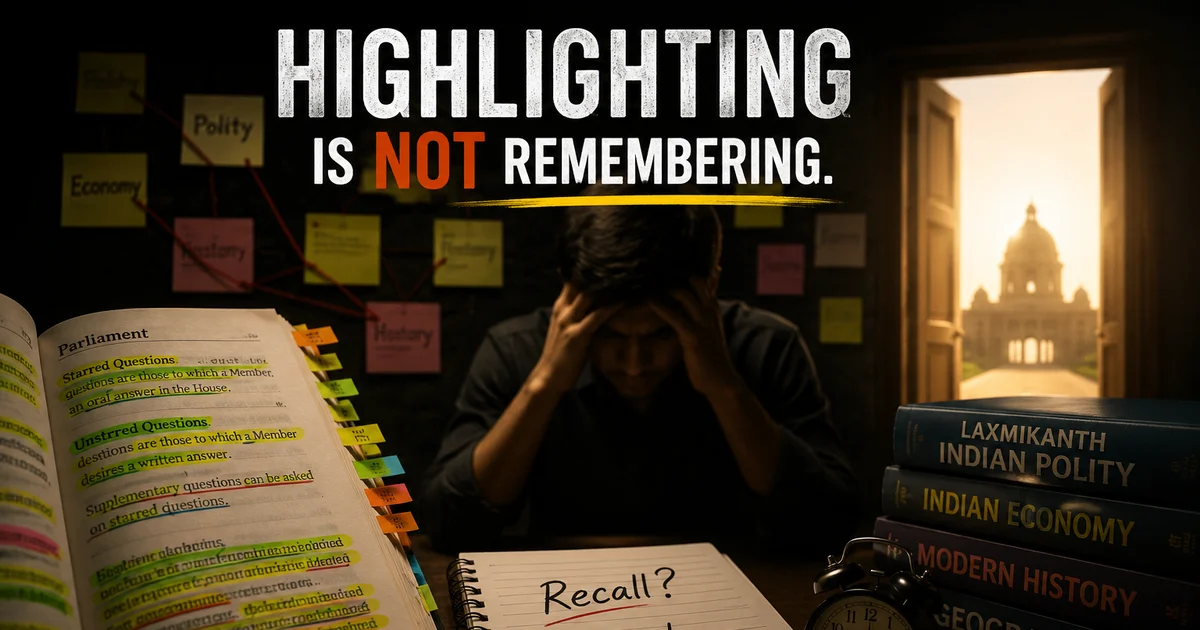
You’ve just finished reading the massive Parliament chapter in M. Laxmikanth (Indian Polity) for the third time. You’ve diligently highlighted the core concepts in yellow and the factual data in green. A week later, you scroll through the pages, see the familiar neon blocks about parliamentary devices, and think, “I know this.”
But then you encounter this exact question from the UPSC CSE Prelims 2026 (Question 58 - Set A):
Consider the following statements in respect of questions asked by the Members in the Parliament of India:
- Unstarred questions are those to which a Member desires an oral answer in the House.
- Starred questions are those to which a Member desires a written answer.
- No supplementary question can be asked on an unstarred question.
Which one of the following conclusions based on the above statements is correct? (a) All the three statements are correct. (b) There are two correct statements, that include statement 2. (c) There is only one correct statement. (d) There is no correct statement.
Suddenly, you freeze. You know you read this. You remember highlighting ‘Starred’ and ‘Unstarred’ in green. But in the pressure of the exam hall, the concepts blur. Does ‘Starred’ mean oral or written? Which one allows supplementary questions? The familiar words are all there, giving you a false sense of security, but the precise connections required to actually solve the question are completely gone.
You didn’t forget because you lack discipline. You fell victim to the “Highlighter Illusion.” Your brain confused the visual familiarity of colored text with actual memory retention. This is the silent bottleneck of UPSC preparation—spending hundreds of hours consuming content, only to realize your actual retrieval capacity is near zero when it matters most.
To fix this, you have to shift from passive reading to structured retrieval. This is exactly why we built Mindcup. Instead of relying on static digital filing cabinets, you can use Mindcup’s active recall revision system to safely log your notes and automatically prompt your brain to retrieve them, ensuring what you read today actually survives until exam day.
What is Recognition Bias in UPSC Preparation?
Q: What exactly is Recognition Bias?
A: Recognition bias is a cognitive illusion where a student mistakes the ease of reading familiar, highlighted text for the ability to independently recall that information. In competitive exams, it creates false confidence, leading to severe memory blanks during high-pressure retrieval tasks like mock tests.
When you look at a highlighted sentence, your brain uses simple recognition pathways. It takes very low cognitive effort to say, “Ah, I’ve seen this before.” Active retrieval, on the other hand, forces your brain to reconstruct information from scratch, building the dense neural pathways required for the UPSC Mains and Prelims.
It is not your fault that your brain prefers recognition; it is a natural, evolutionary shortcut to save energy. But to clear this exam, we have to systematically bypass that shortcut.
Here is how the two mechanisms compare:
| Feature | Passive Recognition (Highlighting) | Active Retrieval (Testing) |
|---|---|---|
| Brain Activity | Low (Visual Cortex) | High (Prefrontal Cortex) |
| Illusion of Competence | Extremely High | Zero (It forces absolute honesty) |
| Long-Term Retention | Poor (Decays in days) | Excellent (Strengthens over months) |
| Best Used For | Initial familiarization | UPSC revision techniques |
How to Force Active Retrieval Digitally
If you are a working professional or a full-time aspirant trying to manage an overwhelming syllabus, you cannot afford to read the same Laxmikanth chapter four times just to make it stick. You need an active recall study method that maximizes every minute of your study session.
Here is a step-by-step process to transition from passive reading to active retention:
- Step 1: Read for Comprehension, Not Coloring. Read a page or a digital topic once to understand the core concept. Keep your digital highlighter put away. This is especially true for iPad or Android tablet note-taking; painting a PDF in neon ink on an app like GoodNotes or Notability is just a digital version of the same passive reading trap.
- Step 2: The “Closed-Book” Synthesis. Close the document. On a blank screen or piece of paper, write down the three main takeaways entirely from memory. If you stumble here, you haven’t grasped the topic yet.
- Step 3: Convert into Active Prompts. Instead of saving the entire block of text, convert those takeaways into question-based prompts. (e.g., “What are the three exceptions to Article 14?” instead of just pasting the text of Article 14).
How Mindcup Neutralizes the Digital Highlighting Bias
Q: How do I actually revise UPSC notes effectively without falling for the illusion?
A: The key is the system you use. Your tools dictate your success. To revise effectively, you must replace passive note repositories with an active, thinking engine that forces you to recall information from memory instead of just re-reading it.
When figuring out how to revise UPSC notes, the system you use dictates your success. Mindcup is designed specifically to prevent the highlighter illusion by acting as an active, thinking engine rather than a passive note repository.
We utilize a process-first revision approach powered by the Free Spaced Repetition Scheduler (FSRS)—a highly precise algorithm that predicts exactly when your brain is about to forget a piece of information, prompting you to review it at the optimal moment. But more importantly, Mindcup structures how you retrieve that data:
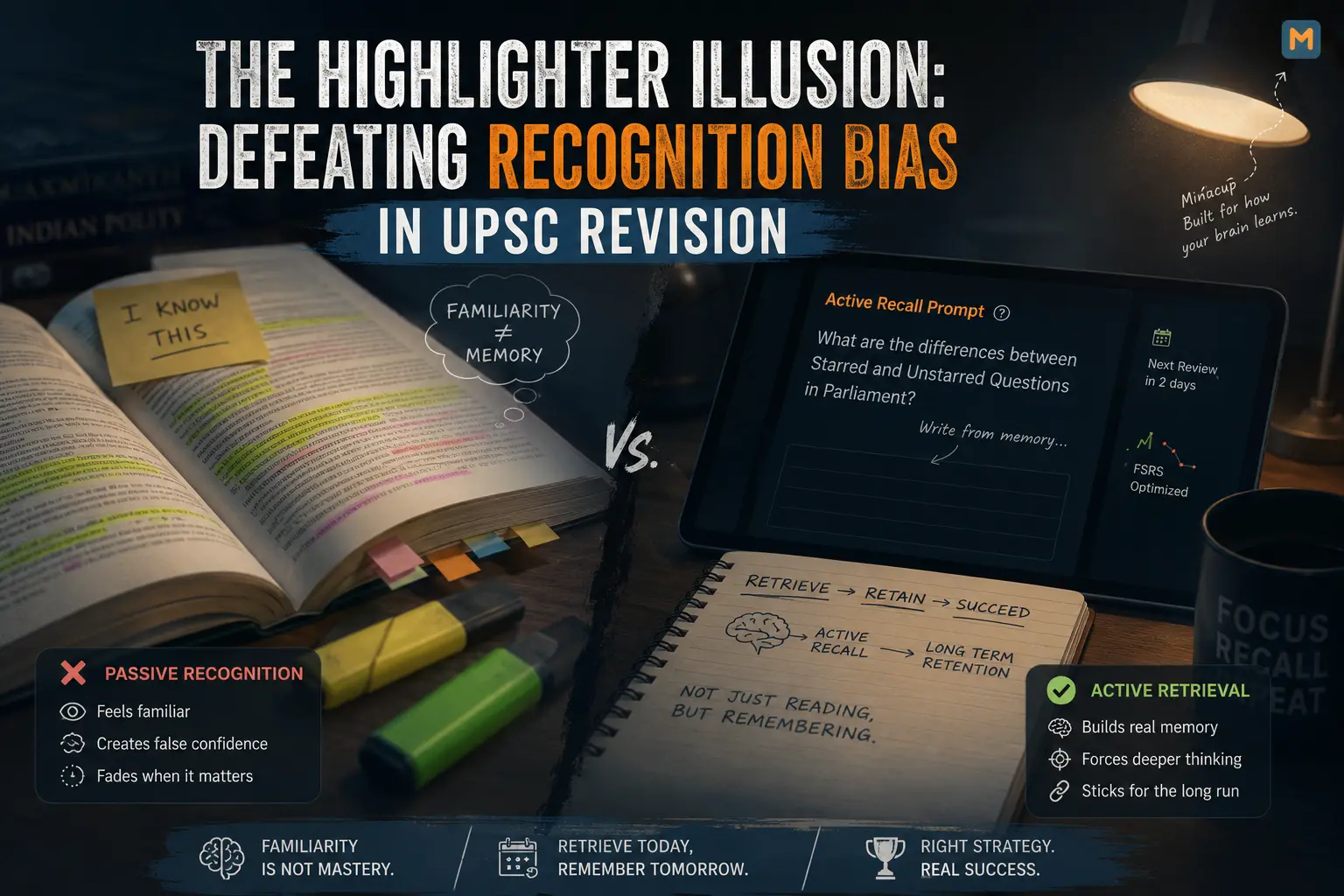
- Guided Active Recall (For the Learning Phase): When a topic is fresh, Mindcup shows you your complete note. You review it, the system hides it, and you are forced to recall the information. You then reveal the content to verify your accuracy. It is a gentle but firm way to build initial memory muscles.
- Unguided Active Recall (For Exam Readiness): As your retention curve strengthens, Mindcup removes the training wheels. You are presented with a blank workspace and a prompt. Because there are no highlighted cues to lean on, your brain is forced to do the heavy lifting. If you can retrieve it here, you can retrieve it in the exam hall.
Build the Right Cognitive Infrastructure Today
For fresh entrants on Day 1, adopting this system prevents you from building a massive, unmanageable pile of passive notes that you will inevitably forget. For the part-time aspirant, it brings absolute precision to your limited hours—a 5-minute unguided recall session on your commute yields exponentially higher retention than two hours of passively scrolling through PDFs.
Your preparation requires structure, retention, and consistency. We handle the remembering, so you can focus on the learning.
Ready to defeat the highlighter illusion? Set up your first structured active recall cue inside the Mindcup interface here, and let our system secure your memory for the long run.