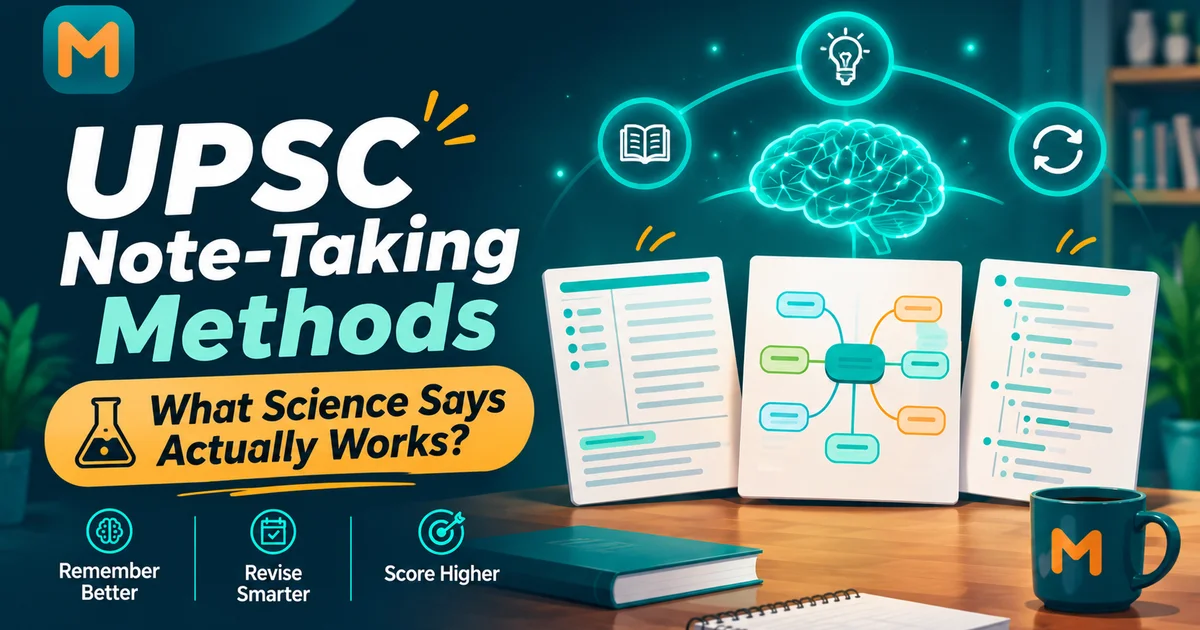
You are six months into your preparation. You have a growing stack of notes — some in registers, some in Notion, some in a Google Doc you forgot about. A topper’s interview says, “I used mind maps for everything.” A coaching faculty insists, “Cornell method is the only scientific way.” A Reddit thread swears by Anki flashcards. Your study circle friend has rewritten half of Laxmikanth into a neat spiral-bound notebook.
Everyone is confident. Everyone contradicts each other. And you are paralyzed, wondering whether the system you have been building for six months is fundamentally wrong.
Here is the uncomfortable reality: most advice about UPSC note-taking is based on anecdote and survivorship bias. You hear what worked for one person who cleared the exam, but you never hear from the thousands who used the exact same method and did not. What you need is not another topper’s opinion — you need to understand the cognitive mechanics of why certain methods work for certain subjects, and more critically, why no method alone is sufficient.
This article examines the four most widely recommended note-taking methods through the lens of peer-reviewed cognitive science, evaluates them against the specific demands of the UPSC Civil Services Examination, and explains the one mechanism that most aspirants completely ignore — the mechanism that ultimately determines whether your notes survive to exam day.
Why This Question Matters More Than You Think
Note-making is not a preference. It is the infrastructure decision of your entire preparation. Getting it wrong at month three means a catastrophic rewrite at month twelve — or worse, realizing in your final revision cycle that your notes are either too bloated to revise or too fragmented to be useful.
Consider the scale of what you are building:
- The UPSC GS syllabus alone contains over 130 unique subtopics across Prelims, GS Papers 1 through 4, and Essay
- The average serious preparation duration is 2 to 3 years
- During that span, your notes will be revised 10 to 20 times more than they will be written
That last point is critical. Your notes are not a one-time output. They are a living revision engine.
One important distinction before we proceed: this article compares note-taking methods — Cornell, mind mapping, outlining, and progressive compression. The separate question of medium — whether to use handwritten notebooks, a tablet, or a digital app — is equally important but involves different cognitive trade-offs. We have covered that debate in depth in our scientific comparison of digital vs. handwritten notes for UPSC. Here, we focus purely on how you structure and organize information, regardless of medium. The method you choose determines how efficiently that engine runs — how quickly you can scan a topic, how easily you can update it with new Supreme Court judgments or government schemes, and how effectively the format triggers genuine recall rather than a false sense of familiarity.
The wrong method does not just waste time. It compounds. Disorganized notes lead to inefficient revision, which leads to poor retention, which leads to panic-cramming before mocks, which leads to the devastating experience of blanking out on topics you studied thoroughly.
So let us treat this question with the seriousness it deserves.
The Four Note-Taking Methods Compared
Rather than listing pros and cons based on opinion, we will evaluate each method against a consistent framework rooted in cognitive psychology: encoding quality, active recall potential, scalability across the UPSC syllabus, and alignment with Mains answer writing.
1. The Cornell Method
How it works: Divide each page into three sections — a narrow cue column on the left (about one-third width), a wide note-taking area on the right, and a summary strip at the bottom. During study, you write your notes in the right column. Afterward, you extract keywords, questions, or trigger phrases into the cue column. The summary forces a one-to-two sentence synthesis of the entire page.
What cognitive science says: The Cornell method was developed by Prof. Walter Pauk at Cornell University in the 1950s. Its genius lies in the cue column. When you cover the right side and attempt to recall the content using only the cues, you are performing what cognitive psychologists call retrieval practice — the act of pulling information out of memory rather than passively reviewing it. Robert Bjork’s research on “desirable difficulties” (1994) demonstrates that this effortful retrieval physically strengthens memory traces, making information more accessible during future high-pressure situations like an exam.
Where it fits in UPSC: Cornell excels for static GS subjects — Polity, Economy, Ethics, and Governance. These subjects require precise definitions, constitutional article references, committee recommendations, and structured arguments. The cue column naturally produces a self-quiz bank: cover the notes, read “Article 21 — Expanded Scope,” and challenge yourself to list the landmark cases. The summary section also forces you to synthesize, which directly trains the concise introduction and conclusion skills needed for Mains answers.
Where it struggles: Cornell’s rigid three-section format makes it difficult to represent topics that demand spatial or relational thinking. If you are mapping the interconnections between climate change, migration patterns, food security, and international cooperation for a GS 3 question, a linear page divided into three boxes feels restrictive. You end up forcing multidimensional content into a one-dimensional layout.
2. Mind Mapping
How it works: Place a central topic at the center of a blank page (for example, “Monetary Policy”). From it, draw branches for major sub-themes (Tools, RBI’s Role, Inflation Targeting, Global Comparisons). Each branch sprouts further sub-branches with specific facts, case studies, or data points. The result is a radial, non-linear visual representation of an entire topic.
What cognitive science says: Mind mapping leverages Allan Paivio’s Dual Coding Theory (1986), which posits that the brain processes verbal and visual information through two separate channels. When you encode information both as text and as a spatial/visual structure, you create two independent retrieval pathways — either one can trigger the memory. Additionally, the branching structure mirrors how the brain’s associative memory networks actually store related concepts, making retrieval more natural.
Where it fits in UPSC: Mind maps are powerful for interconnected, multidimensional topics — Environment and Ecology, International Relations, Geography, Disaster Management, and complex social issues. UPSC Mains questions frequently demand that you analyze a topic from social, economic, political, and ethical dimensions simultaneously. A mind map trains this kind of thinking structurally: you literally see the branches connecting a single issue to multiple dimensions, which translates directly into well-rounded answer writing.
Where it struggles: Mind maps are poor containers for data-dense, linear content. Try fitting the 18 grounds for disqualification of MPs, the exact provisions of the 73rd Amendment, or a chronological timeline of Modern Indian History into a radial diagram — it becomes chaotic. They are also notoriously difficult to update on paper. Discovering a new branch point three weeks later means redrawing the entire map or cramming it awkwardly into existing white space.
3. The Outlining Method (Linear / Bullet Points)
How it works: Organize information hierarchically using headings, subheadings, and indented bullet points. Each level of indentation represents a deeper level of detail. This is the default method most aspirants use — it is how textbooks are structured, how coaching class notes are dictated, and how most people naturally write.
What cognitive science says: Outlining has the lowest cognitive barrier to entry, which is both its strength and its weakness. Mueller and Oppenheimer’s landmark 2014 study, “The Pen Is Mightier Than the Keyboard,” found that students who took verbatim notes (which outlining encourages, especially when typing) performed significantly worse on conceptual questions than those forced to process and rephrase information. The act of outlining can devolve into transcription — your hand writes the words, but your brain never deeply engages with the meaning.
Where it fits in UPSC: Outlining is the safest starting point for absolute beginners and works well for subjects with inherently linear structures — Modern History timelines, Art and Culture classifications, Science and Technology developments. The hierarchical format also maps directly to Mains answer structure: Introduction → Point 1 → Point 2 → Point 3 → Conclusion. If your outline is concise, it essentially is your answer skeleton.
Where it struggles: Outlining carries the highest risk of producing a “mini-textbook” — pages and pages of neatly formatted bullet points that look comprehensive but provide zero active recall stimulus. When you open these notes for revision, you end up passively rereading a wall of text, which triggers the recognition bias that destroys exam performance. There is no structural mechanism that forces you to retrieve the information rather than just scan it.
4. Progressive Compression (The 5-3-1 Method)
How it works: This method operates through iterative reduction across multiple passes. On the first reading, you absorb the material broadly. On the second pass, you extract 5 key points. On the third, you distill those into 3 supporting arguments. On the final pass, you compress everything into 1 core conclusion or case study. Each pass forces deeper processing.
What cognitive science says: Progressive compression aligns with Craik and Lockhart’s Levels of Processing Theory (1972), which demonstrates that information encoded at a deeper semantic level (meaning-based processing) is retained far longer than information processed at a shallow, surface level (reading the words without engaging with the meaning). Each compression cycle forces you to ask: “What is truly essential here? What can I discard?” This is a form of active elaboration that strengthens encoding.
Where it fits in UPSC: This method is exceptional for current affairs and editorial analysis. The daily challenge for UPSC aspirants is transforming a 1,200-word The Hindu editorial into a Mains-usable data point. Progressive compression provides a systematic pipeline: read the editorial → extract 5 key arguments → identify 3 data points or precedents → crystallize 1 usable conclusion. The output is a compact, revision-ready note that directly feeds into GS Paper 2/3 answers.
Where it struggles: Progressive compression assumes a solid foundational understanding of the subject. You cannot compress what you have not yet comprehended. For a beginner encountering Monetary Policy for the first time, trying to extract “5 key points” is premature — you do not yet know which points matter. This is a method for your second year, not your first month.
The Comparison Matrix
| Criterion | Cornell | Mind Map | Outlining | Progressive Compression |
|---|---|---|---|---|
| Built-in active recall | ✅ High (cue column) | ⚠️ Medium (visual triggers) | ❌ Low (passive re-reading) | ⚠️ Medium (compression forces processing) |
| Ease for beginners | ⚠️ Medium | ⚠️ Medium | ✅ High | ❌ Low (needs prior knowledge) |
| Updatability for current affairs | ⚠️ Medium | ❌ Low (on paper) | ⚠️ Medium | ✅ High (iterative by design) |
| Mains answer alignment | ✅ High | ✅ High (multi-dimensional) | ✅ Very High | ✅ High |
| Handles interconnected topics | ⚠️ Medium | ✅ High | ❌ Low | ⚠️ Medium |
| Revision speed | ✅ Fast (summary section) | ✅ Fast (visual scan) | ❌ Slow (wall of text) | ✅ Fast (compressed output) |
| Risk of verbatim copying | ⚠️ Low–Medium | ❌ Low | 🔴 High | ❌ Low |
| Best subject fit | Polity, Economy, Ethics | Environment, IR, Geography | History, Art & Culture, S&T | Current Affairs, Editorials |
The Uncomfortable Truth: No Method Alone Beats the Forgetting Curve
Here is where we need to be honest about what most UPSC note-taking guides — including coaching institute advice — completely leave out.
All four methods above optimize for encoding: how information enters your brain. The Cornell cue column improves encoding quality. Mind maps add a visual encoding channel. Progressive compression forces deeper semantic processing. These are genuinely valuable differences.
But encoding is only half the equation. Even the most beautifully crafted Cornell notes or the most detailed mind map will decay to near-zero within two to four weeks without a structured retrieval mechanism. This is not opinion — it is a mathematical certainty described by Hermann Ebbinghaus’s forgetting curve in 1885. Without active consolidation, you lose up to 70% of newly learned information within 24 hours.
The research on this is unambiguous:
-
Dunlosky et al. (2013), Psychological Science in the Public Interest: A systematic review of ten common learning techniques found that highlighting and re-reading — the default revision strategy for most aspirants — ranked as “low utility.” Practice testing (active recall) and distributed practice (spaced repetition) ranked as “high utility.” The gap between these categories is not marginal; it is the difference between methods that reliably produce long-term retention and methods that produce the illusion of learning.
-
Karpicke and Blunt (2011), Science: In a controlled experiment, students who used retrieval practice (testing themselves without notes) significantly outperformed students who used elaborate concept mapping on a delayed test — even though the concept mapping group spent more time studying. The act of effortful retrieval, not the sophistication of the notes, determined long-term retention.
-
Roediger and Karpicke (2006), Psychological Science: Repeated testing produced 80% recall after one week, while repeated studying produced only 36% recall over the same period. The testing group studied the material fewer total times but remembered more than twice as much.
Here is what this means for you as a UPSC aspirant: your note-taking method determines the quality of your input, but your revision system determines whether that input survives to exam day. Most aspirants obsess over the first and completely neglect the second. They spend weeks debating Cornell versus mind maps, build an elaborate note-making system, and then “revise” by passively re-reading those same notes — the single lowest-utility study strategy according to the evidence.
The question is not “which note-taking method is best?” The question is: “which note-taking method, combined with which retrieval mechanism, produces the highest exam-day retention?”
What Actually Works: Method + Mechanism
The optimal system is not about picking one method. It is about combining the right method for the right subject with a retrieval mechanism that actively fights the forgetting curve. Think of it as a two-layer architecture:
Layer 1 — Encoding (How You Write):
- Cornell Method → for Polity, Economy, Ethics, and Governance (structured definitions, article references, committee names)
- Mind Mapping → for Environment, International Relations, Geography, and Social Issues (interconnected, multidimensional topics)
- Outlining → for History, Art and Culture, Science and Technology (chronological or hierarchical content)
- Progressive Compression → for Current Affairs and Editorials (daily dynamic content that needs to be distilled into Mains-ready points)
Layer 2 — Retrieval (How You Revise):
- Active Recall → test yourself with notes hidden. Do not re-read; retrieve. The effort of failing and then correcting is what builds durable memory.
- Spaced Repetition → schedule reviews at algorithmically calculated intervals, not arbitrary “revise every Sunday” plans. Each note should be reviewed precisely when your memory of it is about to decay — not before (wasted effort) and not after (forgotten).
- Note-Level Retrieval → keep your full notes intact during review. Breaking a complex GS Paper 3 topic into 100 disconnected flashcards destroys the contextual structure you need for writing 200-word Mains answers. Retrieve the complete argument, not isolated fragments.
Most aspirants have Layer 1 covered, even if imperfectly. It is Layer 2 — the retrieval mechanism — that separates candidates who retain 80% of their syllabus on exam day from candidates who are scrambling to re-read everything in the final month.
How Mindcup Resolves This
We built Mindcup because we realized the note-taking methods debate is incomplete without a scientific revision layer. You bring the method — Mindcup brings the memory. Here is how the platform maps to the two-layer framework above:
The Encoding Layer: Focus on Your Method, Not Your Folder Structure
When you open Mindcup, you do not face an empty workspace. The entire UPSC GS 1-4, Prelims, and Essay syllabus is pre-mapped into a navigable folder structure. You are not spending your first three weeks building a Notion database with relational properties and custom tags. You select a syllabus topic, open the rich-text editor, and start writing — using whichever note-making method suits that subject.
The editor supports the full formatting depth you need: headings, subheadings, bullet points, bold, italics, and structured layouts that accommodate Cornell-style organization, hierarchical outlines, or compressed summaries. Your notes are not fragmented into flashcards. They remain complete, contextual, rich-text documents — exactly the kind of full-context material your brain needs for long-form Mains answer retrieval.
The Retrieval Layer: Automated Memory on Autopilot
This is where the two-layer system comes together. Every note you write in Mindcup is automatically enrolled into a spaced repetition schedule powered by the FSRS (Free Spaced Repetition Scheduler) algorithm. FSRS does not use rigid, static intervals like “revise after 1, 7, and 30 days.” It uses machine learning to calculate your unique memory stability for each individual note, predicting the precise moment your retention is about to drop below your target threshold.
The result: every morning, Mindcup generates a personalized daily review queue. You do not decide what to revise — the algorithm does. Topics you remember well get pushed out weeks or months. Topics that are decaying come back sooner. Your daily sessions stay small (15 to 20 minutes), targeted, and high-yield.
Active Recall That Progresses With You
When a note comes up for review, Mindcup does not ask you to passively re-read it. It uses a Guided to Unguided Recall progression:
-
Guided Recall (for newer topics): You briefly see the note to reload the context, then the content is hidden and you attempt to retrieve the key concepts from memory. This bridges the gap between passive reading and full retrieval, building real memory pathways from the start.
-
Unguided Recall (for maturing topics): The note is completely hidden from the outset. You must reconstruct the core argument from scratch before seeing the original. This is the ultimate simulation of exam conditions — and it is the “desirable difficulty” that Bjork’s research identifies as the most powerful driver of long-term retention.
The Scratchpad Method: Best of Both Worlds
One practical recommendation: keep a rough, inexpensive notebook on your desk. When Mindcup prompts an unguided recall session, spend 60 seconds scribbling keywords, structural outlines, or quick mind map fragments on paper before clicking to reveal the note. This combines digital organization and searchability with the tactile motor-memory benefits of physical handwriting — exactly when it matters most, during active retrieval rather than passive input.
The Bottom Line
The debate between Cornell, mind mapping, outlining, and progressive compression is real — and the right choice genuinely depends on the cognitive demands of each subject. But that debate is incomplete without confronting the deeper question: what happens to your notes after you write them?
The evidence from decades of cognitive psychology research is clear. The method matters for encoding quality. But it is the retrieval mechanism — active recall scheduled through spaced repetition — that determines whether your six months of meticulous note-making translates into confident, detailed answers on exam day, or dissolves into a vague sense of “I studied this somewhere.”
You do not need more PDFs, more highlighting, or a more beautiful Notion template. You need a system where the notes you write today are automatically and scientifically surfaced for retrieval exactly when your brain needs the reinforcement.
That is what Mindcup was built to do. Start building your scientific revision system today — free, with no credit card required.