You spent four hours on the Fundamental Rights chapter in Laxmikanth. You highlighted the key articles, understood the exceptions, and closed the book feeling confident. Two days later, a sectional mock test asks about Article 21 — and your mind is blank.
Panic sets in. “Do I have a terrible memory? Is the UPSC syllabus just too massive?”
Take a deep breath. You do not have a bad memory. What you are experiencing is a universal biological phenomenon that every aspirant faces. Your brain is aggressively discarding information it has no evidence you will need again — and until you change your UPSC revision strategy, you will keep feeling like you are pouring water into a leaky bucket.
This guide explains the science behind why you forget, and gives you a concrete, research-backed system to fix it — even if you are less than two years into your preparation.
What Is the Ebbinghaus Forgetting Curve?
Q: What is the Ebbinghaus Forgetting Curve?
A: The forgetting curve is a mathematical model of memory decay discovered by German psychologist Hermann Ebbinghaus in 1885. It shows that newly learned information fades at a predictable, exponential rate — with the steepest drop occurring in the first 24 hours. Without intervention, you can lose up to 70% of what you studied in a single day.
Ebbinghaus tested his own recall by memorising nonsense syllables — meaningless three-letter strings like ZOF or QAX — and tracking how quickly they disappeared. Because the syllables carried no associations, no story, and no logic to anchor them, his curve represents the worst-case scenario of human forgetting: pure decay, stripped of comprehension.
Here is the brutal timeline his data revealed:
- After 20 minutes: roughly 42% of the material is already gone.
- After 1 hour: retention drops to about 44%.
- After 1 day: only 31–34% of the information survives.
- After 1 week: retention can fall as low as 10–15%.
A modern replication by Murre and Dros (2015), published in PLOS ONE, confirmed these numbers with striking accuracy — finding only 31.7% retention at one day without any review.
Your brain is not failing. It is doing exactly what it was designed to do — prioritising information it has evidence you will need again, and discarding everything else.
The curve also carries a quieter consolation. Ebbinghaus discovered what he called “savings”: relearning forgotten material takes significantly less effort than learning it from scratch. The memory trace is not erased — it is buried. What determines whether you exploit that saving or waste it is when you return.
Why the Forgetting Curve Hits UPSC Aspirants Harder
If the curve measures the worst case, why do UPSC aspirants still struggle so much? Because a surprising amount of the Civil Services syllabus behaves exactly like those nonsense syllables.
Think about the material you study daily:
- The year a particular dynasty’s capital shifted.
- The exact article number governing a specific tribunal.
- The mascot and vector of a disease in a current affairs brief.
- A Census figure or a Five-Year Plan target.
These are arbitrary pairings — facts with no internal logic connecting them. They fall off the forgetting cliff fast.
Contrast this with conceptual subjects like Ethics, Economics, or the structural spine of Polity. Once you genuinely understand why separation of powers exists, the structure is held together by reasoning rather than rote. Recall reconstructs itself from logic, and the curve naturally flattens.
The practical takeaway: Revise your arbitrary facts frequently and briefly; revise your conceptual subjects less often but more deeply. The challenge is that any serious UPSC preparation contains both types of material, decaying at different rates, across a dozen subjects simultaneously.
The “Leaky Bucket” Syndrome: What Most Beginners Get Wrong
If you are in your first or second year of preparation, chances are your study workflow looks something like this:
- Read a chapter cover to cover.
- Highlight important passages in multiple colours.
- Move on to the next chapter.
- Feel a growing anxiety that you are “forgetting everything.”
- Re-read the first chapter to ease the anxiety.
This is the Leaky Bucket Syndrome. You keep pouring water (new reading) into a bucket riddled with holes (no timed revision), and then wonder why the bucket never fills up.
The core mistakes beginners make:
- Confusing familiarity with knowledge. Highlighting and rereading feel productive, but they exploit recognition — your brain’s lowest-effort memory pathway. The exam hall tests retrieval, a fundamentally different skill. We break down why this trap is so dangerous in our guides on the highlighter illusion and passive rereading.
- Chasing coverage over retention. The instinct in year one is to race through the syllabus because finishing it feels like progress. In reality, reading Modern History in October while forgetting Ancient History from June is negative-sum work. You are running on a treadmill.
- Ignoring the first 24 hours. The forgetting curve’s steepest drop happens immediately. A single 10-minute recall session within the first day preserves more information than two hours of rereading a week later. Most beginners never place that first intervention.
The forgetting curve is the scientific proof that what matters is not how much you read, but how strategically you return to what you have already read.
The Antidote: Spaced Repetition and Active Recall
Two cognitive principles, used together, can flatten the forgetting curve and turn short-term study sessions into permanent knowledge.
1. Spaced Repetition: Intercepting Decay on Time
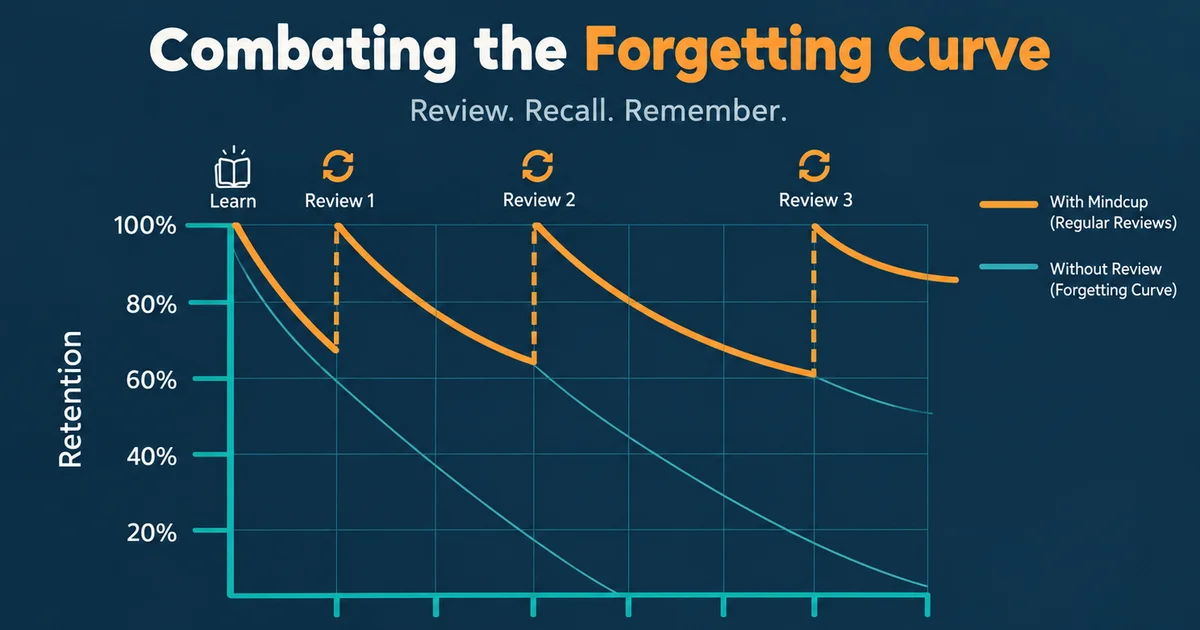
Spaced repetition involves reviewing material at gradually increasing intervals. Instead of cramming all your revision into the week before Prelims, you strategically interrupt the forgetting curve right before your brain is about to delete the information.
When you successfully recall information just as you are about to forget it, you flatten the curve. Each successful retrieval pushes the next forgetting point further into the future.
The standard, scientifically backed interval pattern:
| Review | Timing | What Happens |
|---|---|---|
| 1st Revision | 24 hours after study | Catches the steepest part of the decay curve. A forgetting curve study found the optimal review point for maintaining retention above 80% is approximately 1.098 days. |
| 2nd Revision | 3 days later | The trace has weakened but not vanished. The mental effort of retrieval at this point is what strengthens the pathway. |
| 3rd Revision | 7 days later | Material has survived two retrievals and is approaching durable storage. |
| 4th Revision | 21 days later | By now, the information is deeply embedded in long-term memory. |
By the fourth revision, a topic that once needed daily reinforcement can survive months without attention.
2. Active Recall: Why When You Retrieve Matters as Much as Whether You Retrieve
Active recall — closing your notes and forcing your brain to reconstruct information from scratch — is the single most effective study technique for long-term retention. For a full breakdown of practical techniques (closed-book blurting, the Feynman method, PYQ-based pre-testing), see our dedicated guide on why passive rereading fails for UPSC.
What this post adds is the timing dimension. Active recall and spaced repetition are not separate strategies — they are two halves of the same mechanism. Here is why:
- Recall at the right interval creates “desirable difficulty.” If you test yourself 30 minutes after reading, the material is still in working memory — retrieval is easy, and the strengthening effect is minimal. If you wait a full day, the trace has weakened just enough that pulling it back requires real cognitive effort. That effort is what rewires the neural pathway.
- Recall too late forces relearning, not retrieval. Wait two weeks without any review, and you are not retrieving a fading memory — you are starting from zero. The “savings” effect means relearning is faster than the first pass, but you have lost the compounding benefit of timed retrieval.
- The sweet spot shifts with each successful recall. After your first successful retrieval at day 1, the optimal next retrieval moves to day 3. After that, day 7. After that, day 21. Each successful retrieval pushes the sweet spot further out — which is exactly what the 1-3-7-21 framework above captures.
For beginners: You do not need to start with perfect recall. Even a 60-second recall attempt after each sub-topic — placed within 24 hours — builds retrieval pathways that three rounds of rereading never will. The key is to make timed retrieval a daily habit from Day 1.
Building a Long-Term Revision Schedule: The Temporal Ridgeline
The 1-3-7-21 cadence handles a single topic. A real UPSC preparation cycle, running 18 to 24 months, handles hundreds. What you are actually trying to ride is a temporal ridgeline — the narrow band of timing where a topic is weak enough that retrieving it strengthens the memory, but not so far gone that you are relearning from scratch.
That ridgeline widens as material matures. In practice, well-established topics need progressively wider gaps — roughly one week, then three to four weeks, and finally two to three months between reviews. Early revisions are tight and frequent; later ones stretch out, costing less time per topic as the curve flattens.
Here is the logistics gap that most aspirants underestimate:
- 15+ subject areas, each with dozens of distinct topics.
- Hundreds of individual topics, each entering your study system on a different date.
- Each topic on its own escalating ladder of review dates.
- Different material types decaying at different rates — arbitrary facts needing short intervals, conceptual subjects needing longer but deeper reviews.
To put a number on it: if you study 5 new topics per week across your first year, by month six you are managing roughly 130 active topics — each on a different position in its own interval ladder. By month twelve, that number approaches 260. No wall chart or colour-coded spreadsheet survives that arithmetic. This is not a discipline problem. It is a scheduling problem, and scheduling problems want a scheduler.
The Execution Problem: Why Knowing the Science Is Not Enough
Understanding the forgetting curve is the easy part. The hard part is sustaining the system across a preparation cycle that runs 18 to 24 months.
Consider the scheduling arithmetic. With 260 active topics by month twelve, each on a different review interval, you need to make roughly 15 to 20 scheduling decisions every single day — deciding which topics are due, which can wait, and which have slipped past the ridgeline into relearning territory. That is a combinatorial workload that compounds weekly.
Most aspirants attempt this with spreadsheets, wall planners, or flashcard tools. The common failure mode is not laziness — it is administrative fatigue. The cognitive energy spent maintaining the tracking system drains the very energy you need for the retrieval itself. By month three, the system collapses, and you retreat to unstructured rereading — which, as we have established, is precisely the approach the forgetting curve punishes most. For a deeper look at why this retreat happens and how to break the cycle, see our guide on building a process-first revision system.
Once you accept that retention is a function of timing rather than effort, the bottleneck stops being your memory and becomes your schedule. No one wins that fight with a notebook and good intentions.
How Mindcup Automates the Science for You
We recognised that UPSC aspirants need to focus 100% of their cognitive energy on learning, not on calculating revision intervals. This is exactly why we built Mindcup — to close the gap between knowing the science and actually executing it.
Your Personal Forgetting Curve, Computed Daily
When you finish studying a topic — whether it is the features of the Indian Constitution or the latest environmental summit — you simply log it into Mindcup’s syllabus-mapped workspace. The system takes over, automatically calculating your optimal spaced repetition intervals using the FSRS (Free Spaced Repetition Scheduler) algorithm.
Unlike a static 1-3-7-21 calendar, FSRS adapts to your actual forgetting curve. If you rated a topic as difficult during your last retrieval, the algorithm shortens the next interval. If you recalled it effortlessly, the interval stretches. Over weeks, the system learns the precise decay rate of each topic in your personal memory — so every review is placed at the mathematical sweet spot of the temporal ridgeline.
Every day, you wake up to a clean, optimised dashboard telling you exactly which topics to revise. No spreadsheets. No missed deadlines. No scheduling decisions.
Built-In Active Recall, Not Just Reminders
Mindcup does not simply remind you to re-read. It structures retrieval using a guided-to-unguided recall progression that increases cognitive difficulty as your proficiency grows — ensuring every review session targets the exact level of “desirable difficulty” that strengthens the memory trace. For a detailed comparison of how this differs from passive note-taking tools, see our guide on digital vs. handwritten notes for UPSC.
Designed for Early-Stage Aspirants
Getting your revision infrastructure right on Day 1 prevents the devastating “reality check” that hits six months into preparation — when you realise you have forgotten everything from month one. Mindcup trains you to revise systematically as you go, so the pile of unrevised, forgotten material never accumulates in the first place.
The daily session is designed to run in roughly 15 minutes. That is the point. A revision system you abandon in March is worth nothing in the exam hall; one that fits into a lunch break survives the full 18-month cycle.
Summary: Lock In Your UPSC Knowledge
The core principles of memory retention survive any syllabus change:
- Forgetting follows a predictable curve. It is biology, not a character flaw, and it can be flattened by timed intervention — not by longer study hours.
- The first 24 hours are the highest-leverage window. A single revision placed here buys more retention per minute than any other intervention in your entire schedule.
- Arbitrary facts decay faster than understood concepts. Revise dates, figures, and article numbers often and briefly; revise conceptual subjects less often and more deeply.
- Active recall beats re-reading. Writing a timed answer with your notes closed, or teaching a concept aloud, is the only honest test of what you actually hold.
- Intervals stretch as topics mature. Days, then weeks, then months — which means every topic in your syllabus is on a different clock.
- Manual scheduling breaks under the weight of the UPSC syllabus. Automate it, or lose the battle to administrative friction.
The forgetting curve is not negotiable, but your schedule is. Stop re-reading chapters you have already covered and start intercepting decay on time.
Open your Mindcup workspace, bring in your first subject, and let the scheduler handle the calendar.